
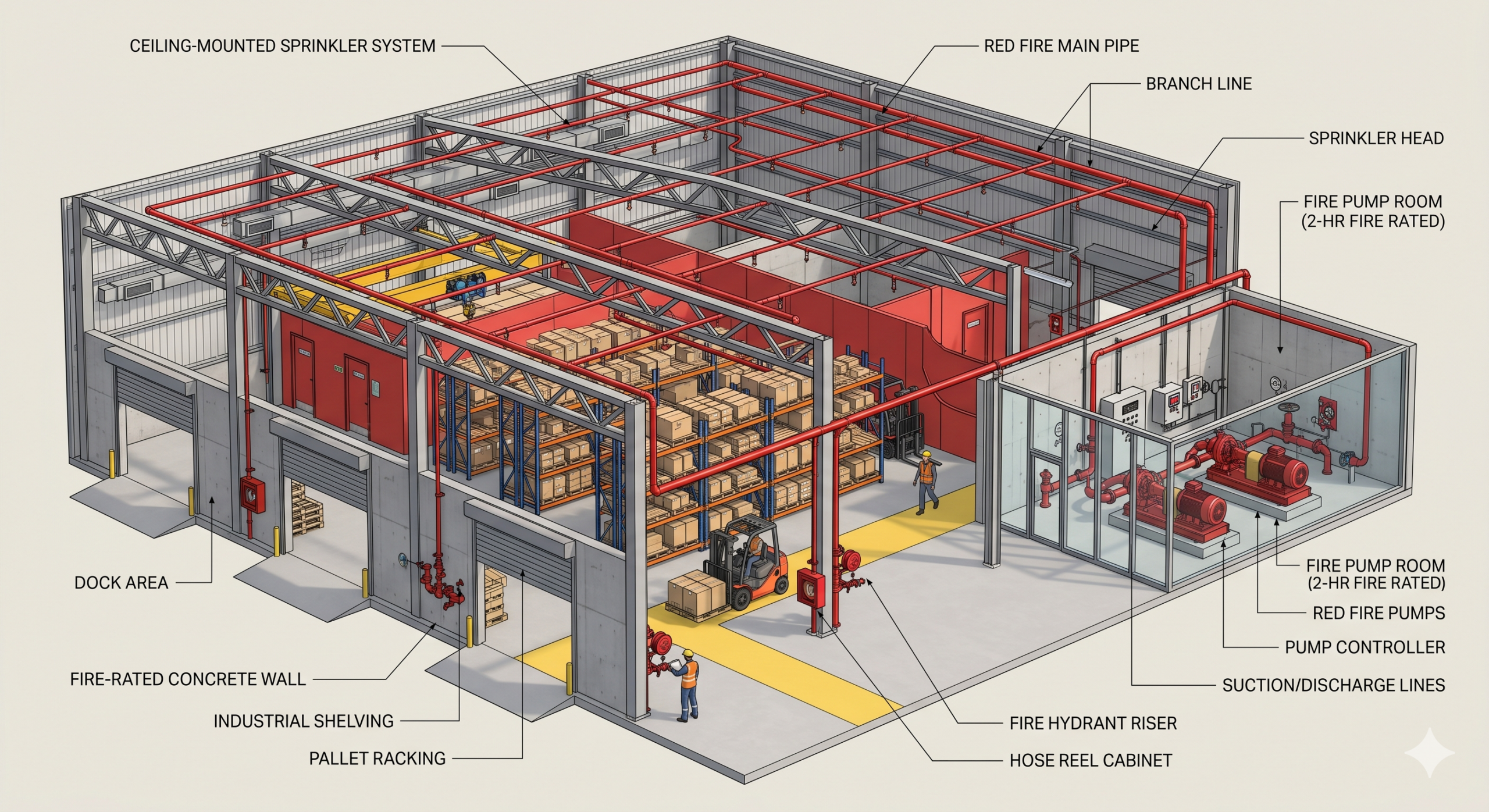
Fire Fighting System Design for Industrial Buildings is a critical cornerstone of modern engineering that ensures the safety of persoel, the protection of high-value assets, and the continuity of business operations. For factory owners and property developers, implementing a robust fire protection strategy is not merely a regulatory requirement; it is a fundamental investment in risk management and long-term sustainability.
In the complex environment of industrial facilities, where flammable materials, high-voltage machinery, and vast warehouse spaces are common, a standard “one-size-fits-all” approach to fire safety is insufficient. Effective fire fighting system design for industrial buildings requires a deep understanding of hydraulic calculations, material science, and international safety codes to provide a reliable defense against unpredictable fire hazards.
What is Fire Fighting System Design for Industrial Buildings?
Fire fighting system design for industrial buildings is the comprehensive process of plaing, calculating, and engineering specialized systems—such as automatic sprinklers, fire hydrants, gas suppression, and advanced detection—tailored to the specific hazards of an industrial site. This process ensures that in the event of a fire, the system can detect, contain, or extinguish the threat with minimal damage to the structure and equipment.
Key components typically include high-capacity fire pumps, water storage tanks, specialized piping networks, and integrated alarm systems that communicate directly with local emergency services. For more complex projects, an integrated design-build system in industrial projects allows for seamless coordination between the fire protection engineers and the structural team.
HTML Alt Text: Fire Fighting System Design for Industrial Buildings featuring sprinkler and hydrant networks.
[TOC]
1. Adherence to International Standards (NFPA)
When engineering a fire fighting system design for industrial buildings, adherence to the NFPA 13 (Standard for the Installation of Sprinkler Systems) is non-negotiable. These standards provide the scientific baseline for water density, pipe sizing, and head placement based on the specific commodity class stored in the facility.
For Indonesian projects, compliance with the National Standardization Agency of Indonesia (SNI) is also mandatory. By merging international NFPA standards with local regulations, companies like Tri Mulia Bangun Persada ensure that industrial facilities are globally compliant and ready for rigorous insurance audits. This dual-compliance approach reduces liability and ensures the highest level of life safety.
2. Comprehensive Site Survey and Hazard Analysis
The design process must begin with a detailed site research and survey. Engineers must categorize the facility based on its “Occupancy Hazard Classification,” which ranges from Light Hazard to Extra Hazard. A chemical processing plant, for instance, requires a significantly different suppression strategy than a cold-storage warehouse.
During the survey, our team evaluates the availability of water supply, the proximity of external fire departments, and the specific layout of heavy machinery. This data allows for a customized fire fighting system design for industrial buildings that addresses specific high-risk zones, such as electrical rooms or chemical storage areas, with targeted solutions like CO2 or clean-agent suppression.
3. Hydraulic Calculations and Pipe Sizing
The core of any effective fire fighting system design for industrial buildings lies in precise hydraulic calculations. Engineers use specialized software to simulate water flow through the entire pipe network, ensuring that the fire pumps can deliver the required pressure and volume to the most remote “hydraulically demanding” area of the building.
Improper pipe sizing can lead to system failure during an emergency. If pipes are too small, friction loss will prevent the water from reaching the necessary pressure. Conversely, oversized pipes increase project costs uecessarily. Our factory and warehouse construction services prioritize value engineering to find the perfect balance between safety and budget.
4. Integration of Mechanical and Fire Fighting Services
A fire protection system does not exist in a vacuum. It must be perfectly integrated with the building’s overall mechanical, electrical, and plumbing (MEP) infrastructure. For example, when a fire alarm is triggered, the HVAC system must automatically shut down or switch to smoke extraction mode to prevent the spread of toxic fumes.
At Tri Mulia Bangun Persada, we specialize in construction services and factory and warehouse management that unify these disparate systems. This integration ensures that the fire pumps have a dedicated, fire-rated power supply and that the fire alarm control panel provides real-time data to facility managers and emergency responders.
Comparison: Active vs. Passive Fire Protection
A holistic fire fighting system design for industrial buildings includes both active and passive elements. Use the table below to understand the differences:
| Feature | Active Fire Protection (AFP) | Passive Fire Protection (PFP) |
|---|---|---|
| Definition | Systems that require action or motion to work. | Systems built into the structure to contain fire. |
| Examples | Sprinklers, fire extinguishers, smoke detectors. | Fire-rated walls, fire doors, intumescent coatings. |
| Function | Detects and extinguishes the fire. | Slows the spread of fire and smoke between compartments. |
| Maintenance | Requires regular testing and mechanical checks. | Requires periodic inspection for structural integrity. |
5. Value Engineering for Cost Efficiency
Budget constraints are a reality for many industrial developers. However, safety caot be compromised. This is where value engineering comes into play. By optimizing the fire fighting system design for industrial buildings, engineers can identify areas where material costs can be reduced without lowering the system’s effectiveness.
For instance, using high-density polyethylene (HDPE) for underground fire loops instead of ductile iron can offer significant savings in both material and installation labor. Our team also specializes in hospital construction services and cost estimates, applying similar rigorous financial logic to ensure every rupiah spent contributes to maximum safety.
HTML Alt Text: Engineering and fire fighting system design for industrial buildings consultation.
6. Selection of Suppression Agents
While water is the most common extinguishing agent, it is not always the best choice for every industrial application. In facilities housing sensitive electronics, data centers, or reactive chemicals, water can cause as much damage as the fire itself. Therefore, a modern fire fighting system design for industrial buildings must consider alternative suppression agents.
Clean agent systems (like FM-200 or Novec 1230) and CO2 systems are essential for protecting electrical rooms and high-value machinery. These systems work by removing heat or oxygen from the fire triangle without leaving behind any residue. Selecting the right agent is a key component of our comprehensive industrial construction insights and plaing services.
7. Maintenance and Life Cycle Management
The most sophisticated fire fighting system design for industrial buildings is useless if it fails to operate during an emergency. Maintenance is the “final stage” of design that never truly ends. Modern industrial facilities should implement smart monitoring systems that alert managers to pressure drops in the fire loop or low fuel levels in the diesel fire pump.
Regular testing of fire hydrants, sprinkler flow switches, and smoke detectors is required by law. At Tri Mulia Bangun Persada, we provide our clients with a complete schedule implementation and maintenance manual to ensure that their investment remains fully operational for decades, protecting both the building and the people inside.
Checklist: Industrial Fire System Design Requirements
- Verification of municipal water supply pressure and flow.
- Calculation of total water storage requirements (Fire Tank sizing).
- Zoning of fire alarm systems for large-scale facilities.
- Selection of appropriate sprinkler head temperature ratings.
- Placement of fire hydrants according to maximum distance rules.
- Integration with emergency lighting and exit signage.
- Coordination with local fire department for Siamese coection access.
Frequently Asked Questions
Why is fire fighting system design for industrial buildings different from residential?
Industrial buildings involve much higher fire loads, larger open spaces (which allow fire to spread faster), and specific hazards like chemicals or high-voltage electricity that standard residential systems caot handle.
What is the most important NFPA standard for factories?
While several apply, NFPA 13 for sprinklers and NFPA 20 for fire pumps are the most critical for industrial fire fighting system design for industrial buildings.
How often should an industrial fire system be inspected?
Generally, visual inspections should occur monthly, while full functional testing of pumps and alarms should be conducted aually or semi-aually, depending on local regulations.
Can value engineering reduce the quality of my fire system?
No. True value engineering focuses on eliminating waste and choosing more efficient materials or layouts while maintaining or even improving the system’s performance and safety rating.
Does TMBP handle the permits for fire systems?
Yes, as a full-service general contractor, Tri Mulia Bangun Persada assists with the plaing, engineering, and administrative process to ensure your system meets all local government safety certifications.
Conclusion
Investing in a professional fire fighting system design for industrial buildings is one of the most important decisions a project owner can make. By focusing oFPA compliance, smart engineering, and integrated MEP services, you protect your workers and your financial future. At Tri Mulia Bangun Persada, we combine decades of expertise with a commitment to quality to deliver world-class fire protection solutions for the industrial sector.
Contact Tri Mulia Bangun Persada today to discuss your industrial, commercial, hospital, or infrastructure project with our experienced engineering and construction team.