
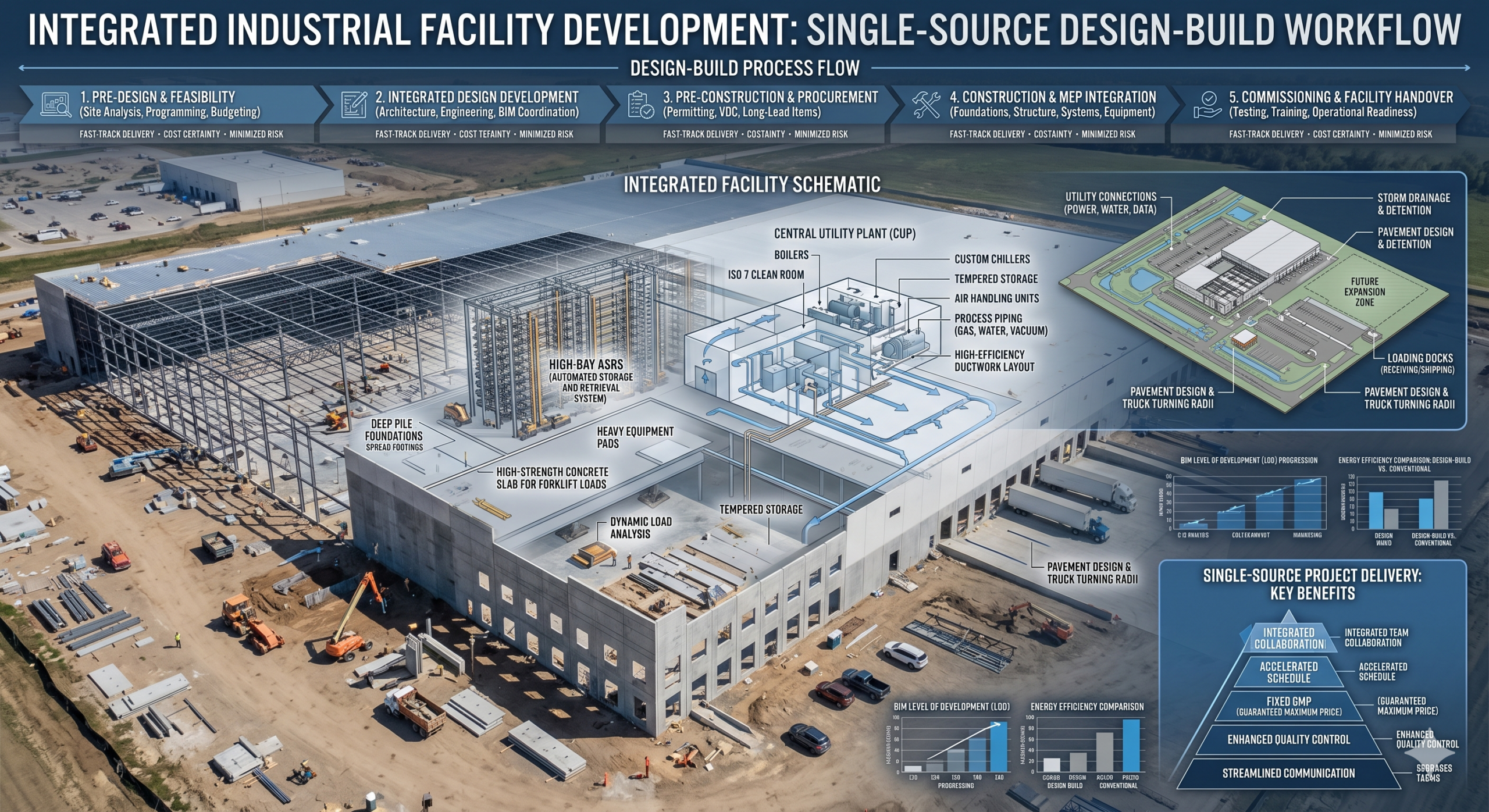
The global industrial sector demands speed, flawless execution, and fiscal predictability. For factory owners, project procurement managers, and institutional investors, traditional construction delivery methods often present systemic bottlenecks—fragmented communication, unexpected cost overruns, and prolonged delivery timelines. To circumvent these liabilities, forward-thinking enterprises are rapidly transitioning to integrated project delivery models. Utilizing professional design build services for industrial projects has emerged as the definitive benchmark for executing complex engineering and construction workflows with maximum efficiency.
By merging the architectural planning, advanced engineering, and physical construction phases under a single point of contractual accountability, industrial firms can compress execution schedules while dramatically lowering financial risks. This comprehensive guide provides an exhaustive analysis of how modern design-build methodologies optimize industrial facilities, ensure structural integrity, and leverage proactive value engineering to deliver high-performance assets.
What Are Design Build Services for Industrial Projects?
To put it simply, design build services for industrial projects represent an integrated construction delivery system where a single entity—the design-build contractor—is entirely responsible for both the planning/engineering phase and the physical construction phase of an industrial asset. Unlike the traditional Design-Bid-Build (DBB) model, which splits design professionals and general contractors into separate, often adversarial silos, the design-build framework unifies all project stakeholders from day one.
For large-scale facilities like manufacturing plants, processing units, and logistics hubs, this unified approach is vital. It guarantees that structural engineering, mechanical installations, and specialized architectural requirements are designed with absolute constructability in mind. By removing the friction between the engineers who draw the plans and the field teams who execute them, industrial owners eliminate costly change orders and communication gaps. Learn more about how this system transforms execution at our specialized overview of the design-build system in industrial projects.
The Structural Phases of an Industrial Design-Build Lifecycle
An elite B2B industrial project requires a systematic, data-driven approach across its lifecycle. The integrated design-build methodology breaks down into several highly collaborative, overlapping phases:
1. Basic Concept Development & Master Planning
Every successful industrial facility begins with a rigorous planning framework. During this initial stage, the design-build team collaborates with the client to outline operational objectives, spatial workflows, and material handling pathways. Master planning incorporates extensive site research, land surveys, and preliminary environmental assessments to ensure compliance with zoning laws and heavy-industrial regulations.
2. Preliminary Estimates & Financial Consultation
A primary failure point in traditional construction is the disconnect between architectural vision and actual budgetary constraints. In the design-build framework, cost estimation happens concurrently with schematic design. Preliminary estimates are refined in real-time, providing procurement teams and investors with financial clarity well before ground is broken. This continuous financial consultation keeps the project tightly aligned with the target capital expenditure (CapEx).
3. Advanced Engineering & Architecture Integration
Once the concept and budget boundaries are secured, detailed structural, architectural, and civil engineering designs are drafted. Industrial buildings require high-load structural configurations, specialized foundation planning for heavy machinery, and customized zoning. Because the engineering team works directly alongside the construction managers, materials and structural components are selected based on localized market availability, lead times, and structural longevity.
4. Procurement, Scheduling, & General Contracting Execution
With designs approved, the project transitions seamlessly into construction. Long-lead items, such as structural steel and heavy mechanical components, are procured early in the design cycle to prevent supply chain bottlenecks. The general contracting phase is executed under strict schedule implementation protocols, utilizing advanced project management methodologies to oversee structural erection, roofing systems, and interior optimization.
Traditional Design-Bid-Build vs. Design-Build Services
When selecting a delivery method for capital-intensive industrial facilities, understanding the structural differences between traditional frameworks and integrated design-build services is essential. The following comparison table highlights why the integrated approach consistently yields superior commercial outcomes:
| Evaluation Metric | Traditional Design-Bid-Build (DBB) | Integrated Design-Build Services |
|---|---|---|
| Contractual Responsibility | Split across multiple entities (Separate Architect and Contractor). | Single source of accountability (One contract, one unified team). |
| Cost Overrun Risk | High; design flaws lead to frequent, costly construction change orders. | Low; contractor absorbs design gap risks through early cost validation. |
| Project Delivery Speed | Linear and slow; construction cannot begin until design is completely finalized. | Accelerated / Fast-tracked; construction phases overlap with design finalization. |
| Value Engineering | Reactive; applied late in the process as a cost-cutting measure after bids come in too high. | Proactive; built directly into initial material selection and structural planning. |
| Communication Framework | Fragmented; often results in finger-pointing between design and construction teams. | Collaborative; unified communication channels drive rapid problem-solving. |
Strategic Benefits of the Integrated Design-Build Approach
Deploying specialized design build services for industrial projects delivers measurable commercial and operational advantages directly to an enterprise’s bottom line:
Maximizing Capital Efficiency via Value Engineering
Value engineering is not simply about cutting costs; it is about maximizing the functional value of every dollar spent. In an industrial context, this involves selecting high-performance, cost-effective structural materials, optimizing floor layouts to enhance manufacturing output, and engineering energy-efficient building envelopes. Because estimators and engineers collaborate from day one, value engineering is integrated directly into the initial drawings, reducing waste and structural redundancy.
Accelerated Construction Timelines
In the industrial and logistics sectors, time-to-market is a critical competitive metric. Every week a factory remains under construction represents lost production revenue. Design-build services allow for “fast-tracking”—a process where site grading, foundation excavation, and structural procurement begin while the final interior and mechanical details are still being engineered. This concurrent workflow can compress total project delivery timelines by up to 20% to 30% compared to traditional linear methods.
Advanced Mechanical & Fire Fighting Engineering
Industrial facilities house sophisticated, high-risk operational environments that require complex mechanical infrastructure. Integrated design-build ensures that HVAC systems, industrial plumbing, electrical substations, and automated fire suppression networks are designed in tandem with the building’s structural frame. This precise integration prevents physical spatial conflicts during field installation, ensuring that fire fighting infrastructure meets stringent international safety and regulatory codes without requiring field modifications.
Key Criteria for Selecting an Industrial Design-Build Partner
Executing an industrial asset requires a contractor with specialized technical expertise, financial stability, and a proven safety track record. When vetting general contracting firms for your facility, ensure they possess the following core capabilities:
- Engineering-Driven Solutions: The contractor must have an in-house engineering team capable of solving complex structural, geotechnical, and mechanical challenges rather than relying completely on outsourced consultants.
- Comprehensive Safety & Environmental Management: Industrial jobsites carry heightened operational risks. Your partner must enforce zero-accident safety protocols and robust environmental management systems to protect your enterprise from legal and compliance exposure.
- End-to-End Execution Capabilities: Partner with a firm that manages the entire lifecycle, from initial site survey and master planning to construction management and final equipment commissioning.
For organizations looking to construct custom industrial assets, exploring dedicated factory and warehouse construction services ensures that your facility is built to handle specific automated workflows and high-capacity floor loads. For a deeper look at comprehensive industrial build solutions, visit our central resource on construction services for factories and warehouses.
Frequently Asked Questions
What types of facilities benefit most from design-build services?
Heavy industrial manufacturing plants, automated logistics hubs, cold-storage warehouses, specialized chemical processing facilities, and high-tech assembly operations derive the greatest benefit. These projects feature highly complex mechanical, electrical, and structural interdependencies that require single-source engineering coordination.
How does the design-build model handle cost estimation accuracy?
Unlike traditional methods where costs are unknown until design is complete and bids are collected, design-build offers early cost certainty. Preliminary estimates are developed during the conceptual stage, and real-time pricing feeds directly into the drafting process, minimizing the risk of budget inflation.
Can design-build services lower project risks for factory owners?
Yes, significantly. Under a design-build agreement, the contractor assumes the legal liability for design errors, omissions, and constructability flaws. If a drawing conflict occurs in the field, the contractor is obligated to fix it without charging the owner a premium via change orders.
Does the owner lose control over design decisions in a design-build contract?
Not at all. In fact, owners often exercise greater control. The owner remains the central decision-maker during the concept development and master planning phases. The design-build entity acts as an expert advisor, presenting clear cost and schedule implications for every design choice, allowing the owner to make fully informed decisions.
How does value engineering work within an integrated design-build framework?
Value engineering is embedded into every step of the project. Engineers, construction managers, and procurement specialists analyze alternative materials, structural systems, and construction methods early on. This collaboration ensures the facility achieves maximum durability and operational efficiency at the lowest possible lifecycle cost.
Conclusion: Partnering for Industrial Excellence
Maximizing returns on an industrial construction investment requires moving away from fragmented, legacy delivery methods. Utilizing comprehensive design build services for industrial projects gives developers, factory owners, and procurement teams an optimized pathway to balance cost, speed, and exceptional engineering quality. By placing your project under a single source of contractual accountability, you secure predictable budgets, compressed schedules, and a state-of-the-art facility engineered to scale alongside your business operations.
At Tri Mulia Bangun Persada, we deliver integrated, engineering-driven construction solutions customized to meet the strict demands of modern industrial operations. Our team ensures that your project benefits from expert master planning, strategic value engineering, and world-class project management from inception to final handover.
Contact Tri Mulia Bangun Persada today to discuss your industrial, commercial, hospital, or infrastructure project with our experienced engineering and construction team.